
الإشعارات
نشرت من supriya maximize
مصنفة في الأعمال والمشاريع 155 مشاهد
Vascular Access Device Market: Global Trends, Growth Outlook, and Competitive Landscape (2024–2030)
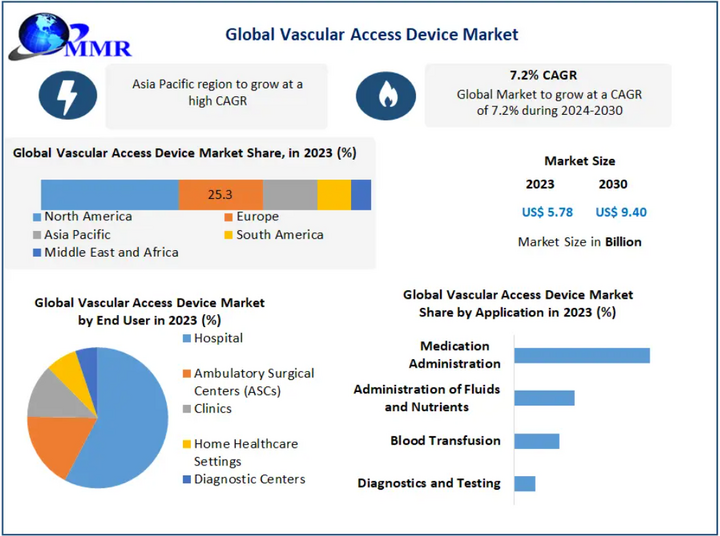
The Global Vascular Access Device Market, valued at US$ 5.78 billion in 2023, is projected to reach US$ 9.40 billion by 2030, expanding at a CAGR of 7.2% over the forecast period. Growth in this market is underpinned by the rising prevalence of chronic diseases, technological innovations in catheter materials, and the increasing shift toward outpatient and home-based care.
Market Overview
Vascular access devices (VADs) serve as a lifeline for patients requiring repeated or long-term access to the bloodstream. These devices—ranging from peripheral IV catheters to central venous access tools like PICCs, ports, and tunneled catheters—enable a wide array of therapies including chemotherapy, hemodialysis, fluid resuscitation, parenteral nutrition, and diagnostic testing.
The growing adoption of these devices in both inpatient and outpatient settings reflects the increasing need for efficient, safe, and minimally invasive vascular access solutions. Continuous technological innovation, such as advanced tip navigation systems and improved biocompatible materials, is reshaping clinical practices and enhancing patient outcomes.
To know the most attractive segments, click here for a free sample of the report:https://www.maximizemarketresearch.com/request-sample/3363/
Latest Industry Developments
Market Dynamics
A major catalyst for market growth is the shift toward ambulatory services and home healthcare. Patients with chronic illnesses, cancer, or those requiring frequent medication benefit significantly from receiving therapy in familiar environments. Vascular access devices make this possible by enabling reliable, extended access for infusion therapy.
Key advantages driving adoption include:
As healthcare systems emphasize cost containment and patient-centric care, VADs are becoming foundational tools in the transition to decentralized medical delivery.
Despite extensive research, device-related thrombosis remains a major challenge. The formation of blood clots around the catheter tip can obstruct blood flow, hinder device function, and increase the risk of embolic events.
For example, Totally Implantable Venous Access Devices (TIVADs) are prone to occlusion caused by:
These complications often necessitate additional interventions, raising healthcare costs and impacting patient safety. As a result, thrombosis-related risks continue to restrain market growth.
Children frequently require vascular access for:
However, conventional devices often cause pain, anxiety, and procedural difficulties. This has led to an industry focus on developing pediatric-specific VADs that:
Future developments will likely focus on:
This niche segment presents a significant untapped opportunity for manufacturers.
Segment Analysis
By Type
The market is segmented into:
Central VADs dominated the market in 2023, driven by their extensive use in critical care, oncology, and long-term treatment settings. Their advantages include:
To know the most attractive segments, click here for a free sample of the report:https://www.maximizemarketresearch.com/request-sample/3363/
Regional Insights
North America – Market Leader
North America held the largest market share in 2023, supported by:
In the United States, nearly 90% of newly diagnosed kidney failure patients opt for hemodialysis, necessitating functional and durable vascular access.
Asia Pacific – Fastest-Growing Region (CAGR 7.5%)
Asia Pacific is expected to witness the strongest growth due to:
Innovations in catheter flexibility and tip navigation are improving physician confidence and boosting demand across the region.
Key Applications
Key End Users
Competitive Landscape
The industry is fiercely competitive, fueled by continuous innovation and the rising need for minimally invasive procedures. Established players are expanding portfolios through advanced product designs, safety features, and improved catheter materials. Meanwhile, emerging firms are targeting niche areas such as biomaterial-based catheters and infection-resistant products.
Prominent Companies
Global
North America
Europe
Asia Pacific
Middle East & Africa
Conclusion
The Vascular Access Device Market is poised for robust growth through 2030 as healthcare systems increasingly prioritize patient comfort, home-based care, and efficient chronic disease management. With significant advancements in catheter design, imaging-guided placement, and biomaterial innovation, the sector is entering an era of improved safety, functionality, and patient-centric solutions. While challenges such as thrombosis persist, ongoing research and clinical innovation continue to pave the way for safer and more durable vascular access technologies worldwide.
More Trending Reports:
Ecotourism Market https://www.maximizemarketresearch.com/market-report/global-ecotourism-market/147136/
India Concrete Block and Brick Manufacturing Market https://www.maximizemarketresearch.com/market-report/india-concrete-block-and-brick-manufacturing-market/46061/
India CNG and LPG vehicle Market https://www.maximizemarketresearch.com/market-report/india-cng-and-lpg-vehicles-market/20201/
India Forklift Market https://www.maximizemarketresearch.com/market-report/india-forklift-market/29716/
Indonesia Electric Vehicle Market https://www.maximizemarketresearch.com/market-report/indonesia-electric-vehicle-market/65817/